Why the World's Most Popular Fruit Is Also Its Most Wasted

Updated: Apr 15
UK mango market is worth £380 million in retail. Globally, mango is an $80 billion industry and the world's most consumed fresh fruit, yet it remains one of the most challenging crops with post-harvest losses reaching 50%.
By Ifat Peled Dinstag, LiVA Co-founder & CEO | 3 min read

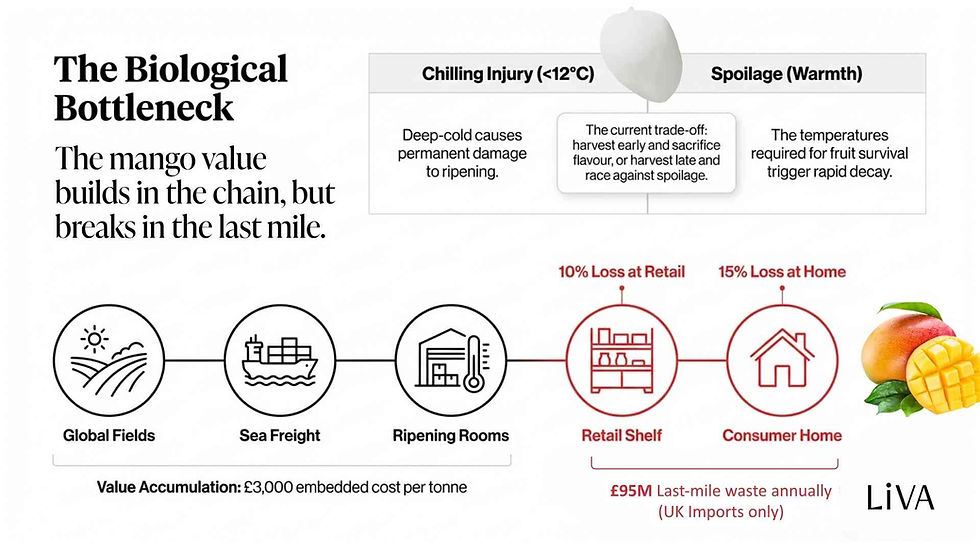
Part of this is biology. Unlike blueberries or table grapes, mango cannot be paused in deep-cold storage. Temperatures below 10 to 12°C cause chilling injuries that permanently damage the fruit's ability to ripen, while the warmth it needs to survive creates ideal conditions for spoilage. This forces a brutal trade-off: harvest early and sacrifice flavour, or harvest at the right time and race against spoilage.
Most post-harvest innovation predicts when fruit will fail. LiVA protects the window in which it succeeds.
The industry has invested significantly in managing the consequences of fruit ripening. This includes larger ripening rooms, ethylene management systems, and 1-MCP treatments to delay over-ripening. Additionally, AI-based demand forecasting is used to improve the timing of deliveries. While these measures help optimize throughput and enhance predictions, they do not address what happens once the fruit is placed in the box.
The Cost Nobody Fully Accounts For
The UK alone imports 87,000 tonnes of mango every year. Around 10% is discarded before it leaves the retail shelf. A further 15% is wasted by consumers at home, as fruit skips the ripe stage entirely. Combined, that is close to £95 million of last-mile waste annually, from a single fruit.
Each wasted tonne carries approximately £3,000 of embedded cost: production, sea freight, cold chain, ripening, and distribution, before a single penny is recovered. For a retailer handling 10,000 tonnes annually, reducing waste by even just 5% is a margin improvement worth £13 million.
The loss lands on every link of the chain: growers facing rejection, importers absorbing disposal costs, retailers marking down stock that should have sold at full price, and consumers paying for fruit that disappoints. When quality is inconsistent, everyone loses at once. British consumers know this pattern well. Mango sits on the counter for three days, still hard. Then it collapses overnight.
The Unrealized Potential of India
India produces 24 million tonnes of mango per year, over 40% of global supply. It is also home to more than 1,000 varieties, including the Alphonso that is widely regarded as the world's finest. Yet in 2023 to 2024, India exported only 32,000 tonnes of fresh mango: merely 0.13% of what it grows.
While India grows the world's finest mango, less than 0.2% of it reaches the global consumer as fresh fruit.
The Alphonso mango cannot survive standard sea-freight temperatures without suffering chilling damages. It requires airfreight, special handling, and a near-perfect cold chain conditions at every point. The result: most of it never leaves India. The gap between Indian orchards produce and what reaches the global consumer is not only a logistics problem, but also a post-harvest issue. Can this predicament be solved or mitigated?
Consistency, Not Prediction
In 2026, during multiple trials with a leading UK mango packer, LiVA applied its prebiotic sticker to standard Brazilian Kent mango cartons and tracked the results throughout the retail window.
At Day 3 (commercial make-or-break point), treated mangoes scored 3.97 out of 5 for taste versus 3.0 for untreated fruit (p<0.001). Brix levels were 15.5 versus 14.5. By Day 6 83% of treated boxes remained above the waste threshold - versus only 17% of untreated boxes. This totaled a 66% reduction in waste and an 82% increase in marketable yield.
The financial return shows that even under conservative estimates, saving only 30% of the fruit results in a net ROI exceeding £1000 per tonne throughout the shelf-life period.
The same infrastructure, the same handling - LiVA technology works inside the box, with the fruit's own biology.

Growing and distributing mangoes is a volatile game, but ‘listening’ to the fruit pays off. By working with its natural attributes rather than against them, we can protect stakeholders’ bottom line and the earth at the same time.